The challenge
Strong awareness wasn't translating into players who stick. The team wanted a major brand initiative grounded in evidence about what actually drives players.
Case 02 · Metacore Games
Merge Mansion was planning a major brand initiative and wanted it grounded in evidence and not just instinct. The deeper question underneath: it has strong awareness, so why doesn't that translate into players who stick?
Strong awareness wasn't translating into players who stick. The team wanted a major brand initiative grounded in evidence about what actually drives players.
A competitor brand and game-health survey of US female mobile gamers, analysed with a GLMM (logit link) that modelled which attributes actually move players to regular play, not just which score well.
Became the evidence base for a major brand initiative that leadership treats as central to long-term growth. The progression findings are now informing design priorities in a current initiative.
The problem isn't that players don't try Merge Mansion.
They try it and don't stick.
The full story
The team was planning a major brand initiative and wanted it grounded in evidence about what actually drives players, not just instinct. The deeper question underneath it: Merge Mansion has strong awareness, so why doesn't that translate into players who stick?
I scoped a competitor brand and game-health study to find out which brand and gameplay attributes build lasting player connections, and how the game compared with others in its space.
I led the study end to end, from framing the research goals through to the readout that informed the brand initiative. I worked closely with Marketing, who owned the decision this research was feeding, and partnered with a Data Scientist on the modelling. I authored the study.
A quantitative survey of US female mobile gamers aged 25 to 59, large enough to compare Merge Mansion against three comparable titles across the full brand funnel: awareness, consideration, trial, and regular play. The survey carried a Likert attribute battery covering story, tone, visual identity, motivation to play, and gameplay attributes.
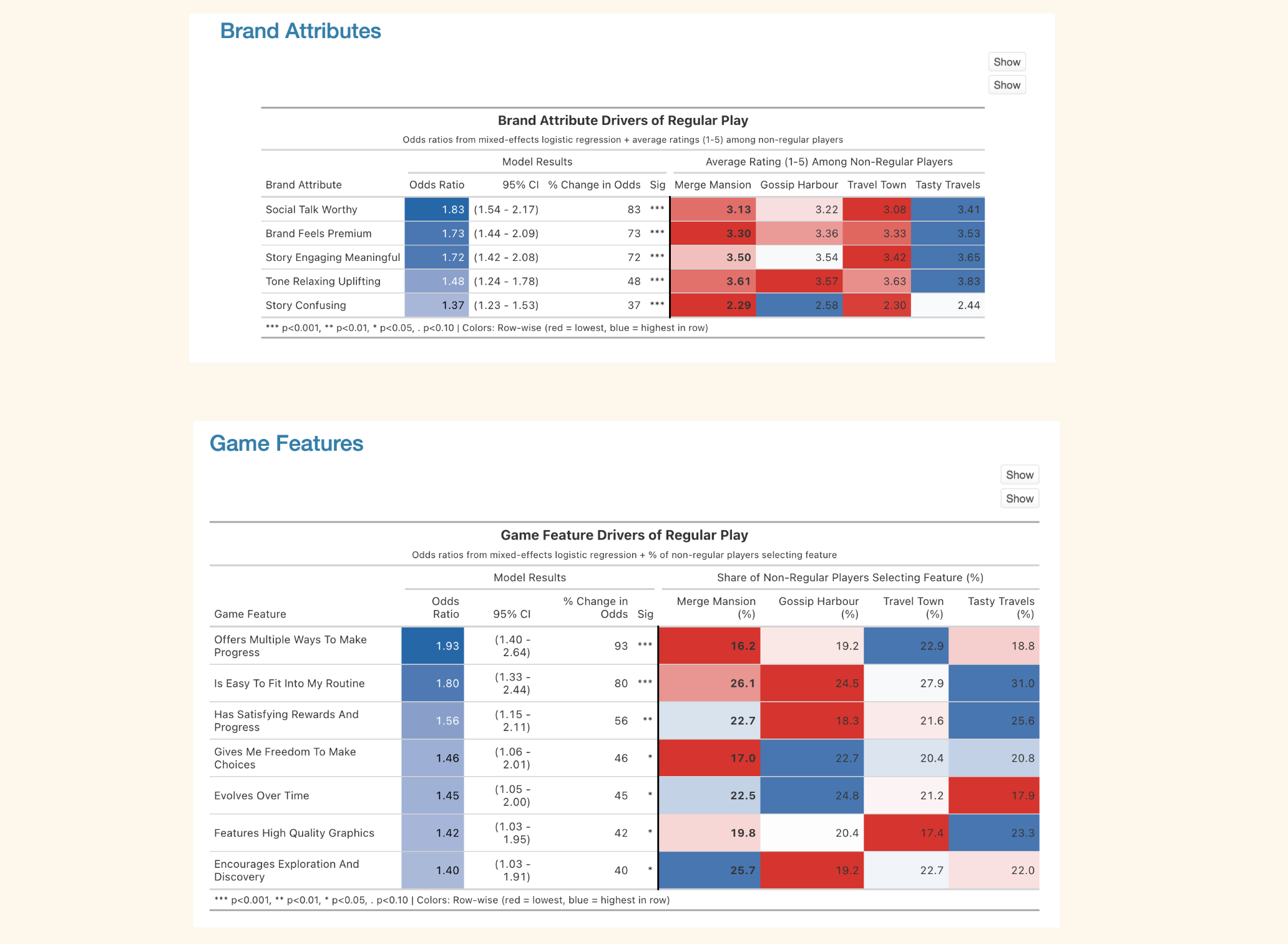
The analytical core was a Generalised Linear Mixed Model (GLMM with a logit link), which let us model the odds of a player becoming a regular player as a function of how they rated each attribute, while correcting for the fact that respondents rated multiple games. Rather than just describing which attributes scored high, this told us which attributes actually move players to regular play, expressed as odds ratios.
I brought the question and what I needed the analysis to answer, and worked with the Data Scientist to explore the options. He selected the GLMM as the right fit. This meant we could separate which attributes genuinely drive regular play from what just scores well in a survey.
Merge Mansion has very high aided awareness but a much weaker rate of turning that awareness into regular players, while a comparable title showed the opposite pattern: modest awareness converting strongly into regular play. So the problem isn't that players don't try Merge Mansion. They try it and don't always stick.
The model identified the attributes that actually drive regular play. On the brand side: being fun to talk about, feeling premium, feeling emotionally engaging, and a light, uplifting tone. On the gameplay side: multiple ways to make progress (the single strongest predictor), fitting into a routine, satisfying rewards, and player agency. The game's measured strengths turned out to be lower-leverage for conversion than these higher-impact attributes.
Two findings gave the team clearer evidence for questions they were already weighing. First, progression flexibility, not difficulty, is the binding constraint on retention, which explained why an earlier difficulty-rebalancing experiment hadn't moved satisfaction. Second, the brand's historical signature underperformed on its own terms, but the read was sharper execution rather than repositioning.
The measured attributes explained only about 15% of the retention gap. I flagged this directly in the readout rather than overselling the model, and framed the rest (likely pacing, monetisation, energy economy, late-game depth) as a clear agenda for follow-up research rather than a settled answer.
The study became the evidence base for a major brand initiative. I helped translate the findings into a focused set of recommendations and grounded the subsequent decisions in evidence, connecting them back to this study and related research so the direction rested on player insight rather than instinct. The work was treated as a strategic priority rather than a surface update.
On the gameplay side, the retention findings are now informing design priorities in a current initiative.